News & Insights

The Dairy Industry at an Inflection Point

Mar 5, 2026 8:32:48 AM / by Chris Laming posted in Debt, Action, Planning, Budget, Banking, Strategy

0 Comments

Capital, Confidence, and the Question of "What's Next?"


Information only disclaimer. The information and commentary in this email are provided for general information purposes only. We recommend the recipients seek financial advice about their circumstances from their adviser before making any financial or investment decision or taking any action.


 The New Zealand dairy industry finds itself in a position that would have been hard to imagine not that long ago. Balance sheets are strong. Cashflows are robust. Debt levels, in many cases, are trending down faster than bankers expected. Payouts have been solid, and the upcoming Fonterra capital distribution is adding another meaningful injection of liquidity into an already well capitalised sector.

On almost every traditional financial metric, dairy is in a position of strength.

And yet, beneath the surface, there is a growing sense of tension, not from stress or distress, but from abundance. When capital is plentiful, confidence is high, and opportunities feel scarce, the real challenge becomes strategic, not operational.

This is where the industry is right now.


A Sector Flush with Capital and Optionality

Most dairy businesses today are operating with strong free cashflow. Years of discipline, improved productivity, and favourable pricing cycles have created a cohort of farmers and owners who are not just surviving but thriving. Debt repayment has accelerated. Working capital buffers are healthy. In many cases, businesses are carrying less leverage than they have in decades.

Interestingly, this strength is now creating a new dynamic with lenders. Bank confidence in the sector is extremely high. Many bankers quietly admit they are more concerned about too much debt being repaid than too little. From a portfolio perspective, dairy exposures are shrinking faster than forecast and that brings its own pressures around balance sheet growth and targets.

This is a rare position for any industry to be in: where lenders are supportive, capital is cheap and available, and risk appetite is strong.

The question is, what do you do with it?


The Scarcity of Dairy Opportunities and the Fear of Missing Out

At the same time, there is a noticeable lack of available dairy assets coming to the market (or more accurately, the fear of). Properties that do come to market attract strong interest, are fiercely contested, and often attract multiple motivated buyers in unconditional positions. Each tender feels like it might be the opportunity and missing out can create a quiet but powerful fear of falling behind.

This scarcity is driving behaviour. It’s encouraging people to stretch, to compromise, or to wait uncomfortably on the sidelines with capital that has nowhere obvious to go. For an industry built on land ownership as the primary wealth engine, the lack of acquisition opportunities creates frustration and strategic paralysis.

Yet scarcity can be a signal, not just a constraint. It often marks the point where the next phase of growth looks different from the last.

Read More

Seven Things to Get Excited About in Farming This Year

Jan 22, 2026 10:01:06 AM / by Andrew Laming posted in Debt, Action, Planning, Budget, Banking, Strategy

0 Comments


Information only disclaimer. The information and commentary in this email are provided for general information purposes only. We recommend the recipients seek financial advice about their circumstances from their adviser before making any financial or investment decision or taking any action.


There has been no shortage of noise in agriculture over the last few years- interest rates, regulation, climate, politics and whipsawing commodity prices. But when you strip that away and look at the fundamentals, 2026 is shaping up as the start of one of the most interesting periods for farming businesses in more than a decade.

Balance sheets are stronger than most realise. The cost of capital has materially reset. Bank appetite is back. Non-bank capital is finally paying attention. And succession, long considered one of the most challenging issues in farming, is starting to be solved with better tools and innovative thinking.

Here are some of our key reasons for optimism:


1. Balance sheets are getting seriously strong.

From a dairy perspective, the last 3–5 years have generated substantial cash across most systems. Dairy debt has fallen to around $18.50/kgMS, down from a peak of approximately $22/kgMS. Adjusted for inflation, the reduction in real leverage is even more pronounced.

Read More

Setting Yourself Up for Success in Sharefarming

Jan 13, 2026 1:24:57 PM / by Jordain Beattie posted in Debt, Action, Planning, Budget, Banking, Strategy

0 Comments


Jordain Beattie
NZAB - Client Director

Louise Gibson
The Sharefarming Consultants


Sharefarming success doesn’t happen by chance. It’s built on clear communication, shared goals, and solid planning from day one. That’s why NZAB and the Sharefarming Consultants have teamed up to share insights from both the financial and practical sides of the equation. Together, we’ve seen that when farmers treat sharefarming as a true business partnership, not just a contract, it creates better outcomes for everyone involved - more trust, stronger performance, and a clearer path to long-term success.

The following insights are shared by Jordain Beattie from NZAB and Louise Gibson from the Sharefarming Consultants, highlighting key areas to focus on when setting yourself up for success in a sharefarming arrangement.


Read More

Strengthening the Future of Agri Capital: NZAB Welcomes John Janssen

Dec 9, 2025 1:22:03 PM / by Scott Wishart posted in Debt, Action, Planning, Budget, Banking, Strategy

0 Comments

 
We’re very pleased to announce that John Janssen has joined the NZAB team. John comes to us with 24 years of experience across different parts of the rural finance sector, having most recently served as Head of Credit with one of New Zealand’s major agri banks. Over his career, John has worked with every type of farming business, from family farm operations to large-scale agribusiness corporates.
Read More

Exclusive Dairy & Agrifood Investment Opportunity - Expressions of Interest Open

Dec 1, 2025 5:11:17 PM / by Andrew Laming posted in Debt, Action, Planning, Budget, Banking, Strategy

0 Comments

We are excited to present an opportunity to invest in Good Guise Group - a vertically integrated Southland dairy farming and fresh-cheese manufacturing business producing premium paneer, queso fresco and emerging specialty cheeses.

This investment offers strong asset backing from a well run dairy unit with identified upside potential, alongside exposure to a growing business in one of the fastest-growing fresh-protein categories in Australasia.

Read More

The NZAB Banking Dashboard

Oct 31, 2025 12:22:28 PM / by Andrew Laming posted in Debt, Action, Planning, Budget, Banking, Strategy

0 Comments

Information only disclaimer. The information and commentary in this email are provided for general information purposes only. We recommend the recipients seek financial advice about their circumstances from their adviser before making any financial or investment decision or taking any action.

We’ve dived back into the RBNZ data to see all the main bank movements over the last six months (to 30 June 2025) - all the changes in lending, who’s winning market share and who’s losing it - in both the Agri and Business Lending Sectors.

This dashboard summarises lending trends across New Zealand’s registered banks to 30 June 2025, based on RBNZ  data and NZAB’s market intelligence. It provides a comparative view of total, agri, and business credit movements, market share shifts, and provisioning patterns.

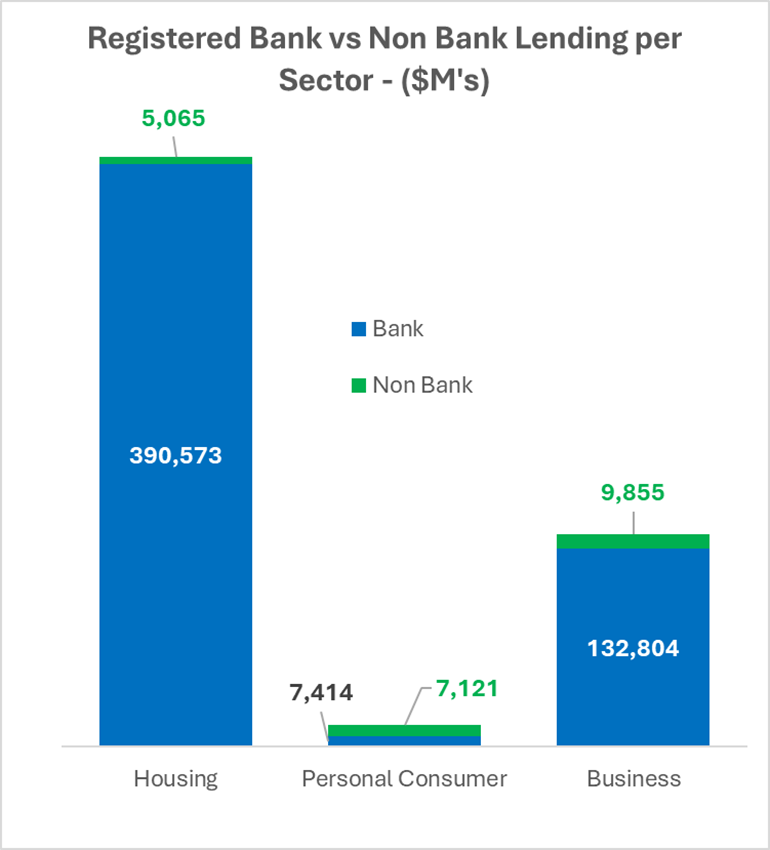
The 12-month period to June 2025 marked a stabilisation phase following two years of sharp monetary tightening. Aggregate bank lending grew by nearly 4% , but that growth was uneven across sectors and lenders. Housing continued to dominate system expansion, while agricultural credit remained flat and business lending advanced modestly.

For agriculture, a slight rebound in dairy and horticultural lending during the second half of the year masked a full-year contraction, reflecting both seasonal working-capital cycles and ongoing deleveraging on the back of strong sector performance. Meanwhile, Westpac and ANZ continued to retreat from agri exposure, with BNZ, ASB, and Rabobank filling the gap.

In business lending, Kiwibank and ASB were the most aggressive lenders, each gaining about half a percent in market share, reinforcing Kiwbank’s ongoing challenger moniker.

Overall, the data highlights a system still cautious on productive-sector credit despite improving farm profitability and moderating risk indicators. Provisioning levels across the agri portfolios declined, consistent with stronger commodity prices and stable repayment behaviour.

This report builds on NZAB’s prior dashboards and provides a factual base for ongoing commentary on capital allocation, bank behaviour, and funding conditions across New Zealand’s rural economy.

With this version, we've also included all of the respective banks' "group" exposures- additional lending that the banks complete in NZ directly from their parent entities.    

As always, if you have any questions, or would like a full digital copy of the data, please email me directly.  

Read More

Rewire the Capital System & Make Access to Capital a National Strategy

Oct 16, 2025 2:52:08 PM / by Andrew Laming posted in Debt, Action, Planning, Budget, Banking, Strategy

0 Comments


Information only disclaimer. The information and commentary in this email are provided for general information purposes only. We recommend the recipients seek financial advice about their circumstances from their adviser before making any financial or investment decision or taking any action.


A few weeks ago, I wrote an article called What Denmark Got Right, comparing how Denmark built an economic powerhouse on the back of their Agriculture industry (their clear strength) and what New Zealand could learn from it.

It generated a lot of positive feedback, clearly the topic struck a chord with many readers asking the same question: how do we actually make those ideas happen here?

This piece continues that conversation by focusing on the first two of the six shifts I outlined, rewiring the capital system and making access to capital a national strategic pillar.

Because until we fix how money flows, everything else we want to achieve in farming and agri-business will remain constrained.

Read More

Unlocking Growth: How Transitional Debt Capital Can Empower New Zealand Farming Businesses

Sep 24, 2025 8:52:03 AM / by Ray Fraser posted in Debt, Action, Planning, Budget, Banking, Strategy

0 Comments

Banks are narrowing, but options are widening. Learn how smart transitional finance is reshaping farming opportunities.


Information only disclaimer. The information and commentary in this email are provided for general information purposes only. We recommend the recipients seek financial advice about their circumstances from their adviser before making any financial or investment decision or taking any action.


Having spent most of my career in Rural Finance with a major New Zealand bank, I was firmly of the view the best way to fund a farming business was through a mix of bank debt and farmer equity. While I had some exposure to alternative capital sources, they were rarely used, typically reserved for distressed assets or situations where traditional funding wasn’t available.

Growing up on a farm, I always had a strong desire to own one myself. This goal sparked a deep interest in understanding the financial pathways to farm ownership and helping others do the same. Supporting farmers achieve their business and family goals became the most rewarding part of my banking career.

However, as bank regulations tightened and risk appetites narrowed, I became increasingly frustrated by the inability to support clients with strong growth plans that didn’t fit the bank’s criteria. Stepping away from banking five years ago gave me the opportunity to help farmers raise equity and explore new funding options. Since joining NZAB 18 months ago, I’ve focused on helping farmers access alternative capital, what we often refer to as transitional debt, to support growth and succession in ways traditional banking can’t always accommodate.

It’s worth noting that most of what NZAB does is still with the main banks. But increasingly, farmers are demanding other forms of capital that banks can’t or won’t provide under today’s regulatory settings.

This experience has opened my eyes to the value and opportunity that transitional capital brings to New Zealand agribusinesses.


What Is Transitional Debt Capital?

Transitional debt capital is short to medium-term funding designed to support farming businesses through periods of change, whether it’s expansion, succession, diversification, or recovery. It’s more flexible than traditional bank lending and can be tailored to suit the unique timing and cash flow of a farming operation. It’s important to note transitional capital is not necessarily about distressed situations, many farmers have strong growth plans that sit outside current bank appetite can and use these options successfully.


Why It’s Valuable in Today’s Banking Environment

Many farmers are finding that their businesses no longer fit within the increasingly narrow criteria of mainstream banks. In fact, many of these transactions are the type of lending that banks traditionally supported, but capital regulations now limit their ability. Whether it’s tighter debt servicing ratios, sector exposure limits, or strategic shifts, traditional lenders may not support the next phase of a farm’s journey, even when the strategy is sound.

Read More

Spring Has Sprung! Are You Bank Ready?

Sep 19, 2025 11:23:11 AM / by Jordain Beattie posted in Debt, Action, Planning, Budget, Banking, Strategy

0 Comments

Creating a strategic advantage in today's Rural Property market.


Information only disclaimer. The information and commentary in this email are provided for general information purposes only. We recommend the recipients seek financial advice about their circumstances from their adviser before making any financial or investment decision or taking any action.


In the agribusiness world, Spring is far more than just a change of season - it marks a period of opportunity in New Zealand’s Rural Property market. Decisions are made to expand operations, purchase new land or restructure business assets. Yet the difference between seizing an opportunity and missing out, often comes down to preparation.

Chatter around the traps suggests this Spring is set to be one of the hottest in recent times, with strong commodity prices, interest rates trending down, and a strong flow of capital into New Zealand agriculture.

‘Bank Ready’ = Market Ready

The ‘Bank Ready’ concept isn’t just about ticking boxes with your bank. It’s about positioning yourself to act with confidence and feel in control of the finance and property purchase process. Lenders are looking for a clear and a well thought out approach to finance application that aligns with your strategy.

We hear and talk about the concept of ‘Bank Ready’, but what does that mean?

I’ve broken this down into three key principles.


1. Knowing your business position gives you confidence to execute

'Bank Ready' farmers and growers who understand not only their financial position but also their risk profile, cashflow position and how it fits within their long-term strategy have the best chance of success in getting competitive debt capital the first time.

It’s not just about today’s balance sheet - it’s about knowing what could go wrong, what contingencies you have, and how you’d respond. Banks stress-test deals. The more context you give around “what if” scenarios, the more confidence they’ll have in your resilience.

Borrowing capacity is another critical factor. Don’t leave this in your bank’s hands; know exactly how they view your position and how much you can borrow. That knowledge gives you leverage, pre-approvals, and the confidence to execute quickly.

This is also the time to ensure you’ve got funding headroom. Expansion is exciting, but it’s vital to raise additional capital while you’re strong - not when the cycle turns. Going in “skinny” leaves no buffer for volatility.


2. Bank Alignment

Read More

When You Think It's Out of Reach

Sep 15, 2025 2:40:46 PM / by Lana Medder posted in Debt, Action, Planning, Budget, Banking, Strategy

0 Comments


Information only disclaimer. The information and commentary in this email are provided for general information purposes only. We recommend the recipients seek financial advice about their circumstances from their adviser before making any financial or investment decision or taking any action.

In farming, opportunities and challenges rarely come at the “perfect” time. A neighbouring block comes up for sale when your equity is stretched. Growth beckons, but the bank says no. Or, on the flip side, pressure mounts from a current lender and selling up feels inevitable.

At NZAB, we see these stories all the time. And while, on the surface, the situation might feel impossible - too far out of reach, too much pressure, not enough support - we’ve learned that with the right approach, there’s nearly always a pathway forward.


1. When Growth Seems Too Big to Grasp

Read More