
Recently, we had the opportunity to facilitate a session at the SIDE conference held in Lincoln on the Pathways to Wealth Creation through partnerships, featuring three farming families who have built multi-farm businesses from scratch by partnering with other people.
These weren't farmers who had inherited operations or started with significant capital, they entered the industry with very little and built substantial wealth over time. They are continuing to grow their businesses now, despite what many feel as a lack of repeatable pathways through the dairy industry today. Success leaves clues, and we've seen a number of them over the years in Agri banking. The key amongst them being:
A growth mindset is critical
A growth mindset is the ability to see opportunity in the hard lessons. It's the recognition that success comes from taking on challenges, being persistent and taking the learnings from failures and criticisms.
Relationships matter above all else
Whether it be your partner or spouse, the farm owner you work for, the advisors you use or the people you surround yourself with, most of the success stories we hear tend to start with a key relationship that enabled great things to happen.
Success doesn't happen in a straight line
Many of the stories of wealth creation involve key moments of failure or loss. Often the gains happened after key moments where things hadn't gone according to plan. Being resilient and having a plan, a 'North Star' of sorts to aim for is critical.
To help frame up a plan, we developed the following framework to help you determine where you are at, and the critical steps to follow.
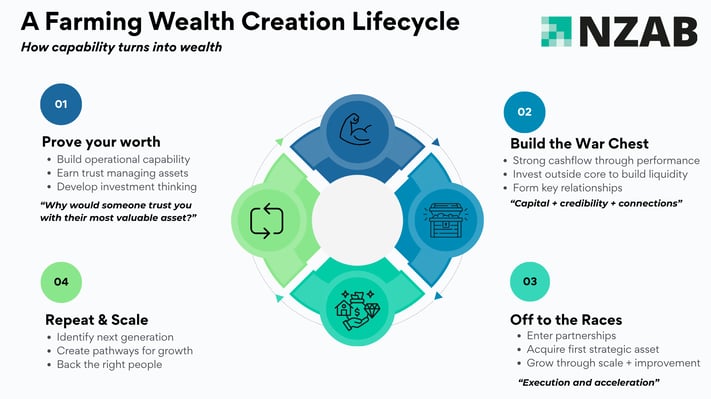
Phase One: Prove Your Worth
This is the stage most emerging farmers want to rush through, but it's the most critical. Before you can build wealth in farming, you need to demonstrate that you can actually execute the fundamental jobs required to produce milk or meat and create value on a farm. It sounds basic, but it's often under valued.
The temptation to skip ahead or push for sharemilking or contract roles is natural, but rushing this stage creates consequences that follow you throughout your career. Particularly when it comes to banking. Banks operate on confidence, so in tough times can you actually make good decisions and ensure that farming operations are efficient and reliable.
Phase Two: Build The War Chest
This phase typically begins with your first foray into business ownership, usually through contract milking, lower order share milking, or similar arrangements.
Fundamentally its about generating cash, and then using these cashflows to create assets for future investments.
This is about leverage. Not just financial leverage, but leverage of your time and attention. Are you investing in assets that will grow your wealth and move you closer to your goals? Or are you spending on depreciating assets like vehicles or personal luxury items?
Equally important during this phase is building relationships. These relationships will set you up for everything that follows.
Look for people with a growth mindset, particularly in the farm owners you work with. A growth mindset treats everything as an opportunity. When things go right, there's an opportunity to learn. When things go wrong, there's an opportunity to learn. When something unexpected happens, the question becomes: how do we find the opportunity in this together?
These relationships and this mindset create the foundation for the next phase.
Phase Three: Off to the Races
With solid relationships and proven capability, you're now positioned to invest and create wealth alongside other people.
The critical element here is entering opportunities as equals. We've seen too many scenarios where people buy themselves jobs by investing a small shareholding in fully valued farms. It looks like you're building equity, but in reality you've just bought yourself a job, often for below-market wages, with limited upside if the asset appreciates, and no ability to leverage or access that capital for future opportunities.
The most successful opportunities are where two (or more) parties collectively go out and acquire an asset together. Maybe it's 50-50, or maybe it's 60-40 based on what each party contributes. But the key is, all parties are acquiring the asset at the same time, at the same valuation, with proportional benefit from any upside.
This structure ensures several things. First, there's alignment around value—both parties have agreed on what the asset is worth because they're both buying in at the same price. Second, there's shared benefit and risk. When the sector has a good year, both parties benefit proportionally. When times are tough, both parties share the pain. Third, and perhaps most importantly, it minimises power imbalances. When you take on a new farm, its new to all of you, you're building something together, not working with someone who happens to have sold you a small piece of their operation.
This is the structure that creates real wealth. There's upside for all parties, and an incentive to acquire and grow assets together. These are the structures that we see lead to multiple purchases over time.
Phase Four: Repeat and Scale
As you develop through the phases, the question becomes how do you scale? By identifying people coming through your business and developing them so they can repeat the cycle with you.
This isn't just about hiring good staff. It's about recognising potential, investing in development, and creating opportunities for others to move through the same wealth creation cycle you've navigated.
When you can do this successfully, you create sustainable scale. Your growth isn't limited by your own capacity, it's enabled by the capability you're building in others.
Final thoughts
The pathways do exist. It's been proven by many farmers before you. But it requires discipline and a clear plan, particularly in those early stages when the temptation to rush ahead is strongest.
If you're on this journey, where are you in the cycle? And more importantly, are you building the foundations needed for the next phase?
.png?width=940&height=348&name=Backing%20New%20Zealand%20Farmers%20with%20Capital%20That%20Fits%20(3).png)
Please feel free to share this newsletter with anyone you think may benefit from the content. You are also able to connect with us using the social media platforms below.
|
|
|


NZAB, 335 Lincoln Road, Addington, Christchurch, New Zealand 8024, 0800 NZAB 12
Unsubscribe Manage preferences