
Information only disclaimer. The information and commentary in this email are provided for general information purposes only. We recommend the recipients seek financial advice about their circumstances from their adviser before making any financial or investment decision or taking any action.
There is no point pretending the pressure on New Zealand’s arable sector is one-off, because a meaningful part of it is real, structural, and unlikely to disappear quickly.
Feed grains continue to operate under a pricing ceiling set not just by domestic demand but by imported alternatives, with PKE or imported grains anchoring the economics of locally grown feed wheat and barley. At the same time, fertiliser, labour, energy, compliance, and finance costs have all reset higher than they were five or six years ago.
Growers are also coming off a tough season in parts of the country, which reinforced a familiar but uncomfortable truth: a good crop in the paddock and a good financial result in the bank account are not always the same thing.
But it would be just as misleading to conclude that arable farming is in decline, because that is not what is actually happening on the ground.
What the 2025/26 season has really exposed is a sector under tension, where the spread between strong outcomes and poor ones has widened materially. Increasingly, success is not just about yield and price, but about how well the business manages the intersection of multiple variables including structure, timing, quality, climate, crop mix, and markets.
This is not a story about one difficult harvest. It is a story about what type of arable business will remain resilient in a more volatile environment.
Why this matters more than it appears
It is important to step back and understand what is actually at stake.
The "arable industry" (which excludes vegetables such as potatoes, carrots, and onions) is a significant part of New Zealand agriculture. While its export profile, at around $350 million, appears modest compared to dairy or meat, that understates its true economic contribution.
Arable production feeds directly into both the human food chain and the livestock sector. When domestic grain is displaced by imports, that value leaves the country rather than circulating within it.
In total, the sector contributes close to $1 billion to GDP, supports more than 11,000 jobs, and drives over $2 billion in direct and indirect economic activity. 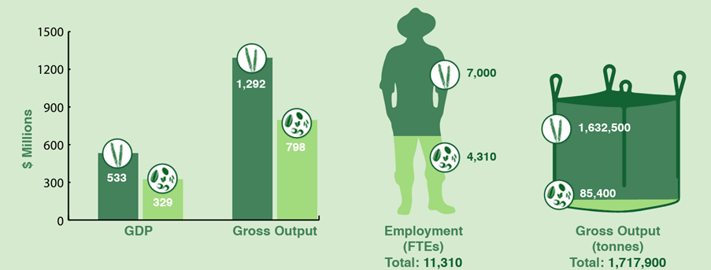
Source: Foundation for Arable Research (FAR)
In that sense, arable is not just another farming category. It is part of the economic infrastructure of New Zealand agriculture.
And yet, it is operating in an environment where margins are tightening and variability is increasing. That combination is what makes the current moment important. Because while the external pressures are largely outside the control of individual farmers, how businesses respond to them is not. The shift now required is from focusing primarily on production, to thinking more deliberately about business strategy, capital, and long-term positioning.
A harvest that split outcomes, not just yields
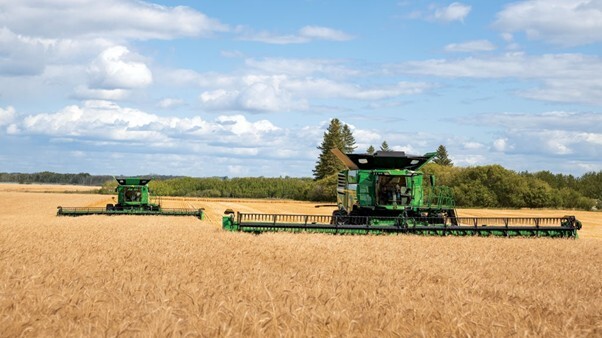
Across Canterbury, the country’s arable engine, the season will be remembered for its variability rather than outright failure.
Rain through January and February arrived at exactly the wrong time, creating a situation where two farms, often only a few kilometres apart, ended up with completely different financial outcomes.
In small seeds, some of the damage was severe. Clover crops in affected areas lost anywhere from 40 percent through to effectively all value due to sprouting and delayed harvest. Ryegrass yields in those same zones commonly declined to around 1.0 t/ha compared to a more typical 1.5–2.0 t/ha.
Yet in the same season, growers who harvested earlier or avoided the worst of the weather still achieved strong outcomes, with ryegrass exceeding 1.8 t/ha and clean clover crops delivering 600–900 kg/ha at premium prices.
Cereals told a similar story. Many wheat crops yielded well, often 10 t/ha or more, but quality became the defining factor. Where milling specification was achieved, returns were solid. Where rain caused sprouting or falling numbers issues, crops were downgraded to feed, stripping out as much as $80–120 per tonne.
On a 10 t/ha crop, that represents a swing of $800–$1,200 per hectare, which is often the difference between a profitable season and one that simply covers costs.
What this season reinforced is that arable is no longer primarily a yield game. It is increasingly a game of execution, timing, and the ability to protect value when conditions turn.
Margins are the real pressure, not production
New Zealand arable farmers can grow crops at a high level. That capability is not in question.
The issue is what those crops are worth relative to what they cost to produce.
On the revenue side, pricing is largely set by global markets. Feed wheat and barley are effectively capped by imported alternatives, with PKE acting as a key reference point for dairy feed economics. Regardless of local production costs, the market will not consistently pay above those substitute values.
At the same time, costs have shifted structurally higher. Where a cereal crop may have cost $2,200–$2,500 per hectare to produce five years ago, it is now more common to see $3,200–$3,800 per hectare.
That change lifts breakeven yields and reduces the margin for error.
The result is a sector where strong yields do not guarantee strong returns, and where downside risk, particularly around quality, has become more financially significant than upside from incremental production gains.
And yet, there are still bright spots
Despite the pressure, this is not a sector without opportunity. It is a sector that is evolving.
The seed industry remains a clear example. Even in a volatile season, top-performing growers achieved materially higher returns per hectare than cereals, particularly where quality was maintained and dressing losses were controlled.
Export demand for ryegrass, clover and other specialist seeds continues to underpin this category. While it carries higher volatility, it also offers higher potential returns.
More broadly, the strongest operators across the country continue to perform. Not because they avoid difficult seasons, but because they manage them better.
They tend to think in systems rather than individual crops, execute well around timing and logistics, and are deliberate about how capital is deployed within the business.
We have been here before, but not quite like this
Arable has faced margin pressure before.
In the early 2000s, low grain prices drove a shift toward dairy. Following the Global Financial Crisis and the subsequent rise in dairy returns, the sector adjusted again, with increased focus on seeds and diversification at one end of the spectrum and simpler systems and integrated dairy support/grazing at the other.
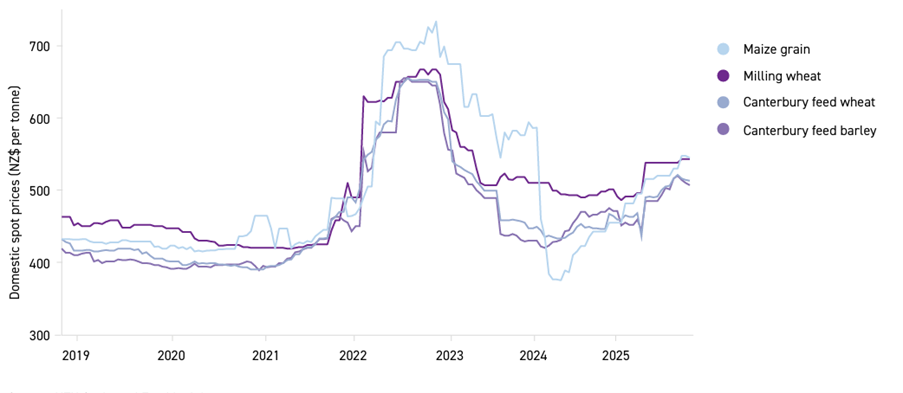
Source: MPI, using NZX Grain and Feed Insight data
Each time, the sector adapted. What is different now is that the traditional release valves are narrower.
Environmental constraints, capital requirements, and regulatory settings limit the ability to shift land use easily. At the same time, global competition is more efficient and more entrenched than it was two decades ago.
This means the sector cannot rely on external change to restore margins. The adjustment now has to come from within each business, itself.
Climate: from seasonal risk to structural volatility
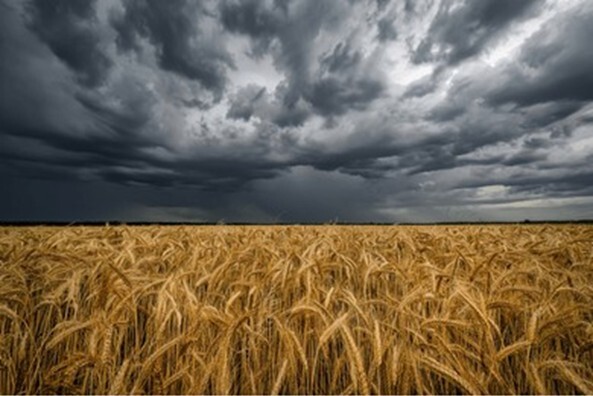
If there is one factor cutting across all of this, it is climate.
The recent season is unlikely to be remembered as a one-off event. It is increasingly representative of a pattern of tighter operating windows, more variable conditions, and greater dispersion in outcomes between farms.
There is an element of luck in that. Small differences in timing or location can materially influence results, and that will always be part of farming.
But what is becoming clearer is that climate is now less a seasonal disruption and more a structural feature of the operating environment. That shifts the conversation from “how do we manage this season” to “how does this business perform across a range of seasons”.
In that context, the focus becomes less about any individual decision in the paddock, and more about how resilient the overall system is to variability.
Some businesses are absorbing that variability and still producing consistent outcomes, for example;
- Growers with established grain contracts and seed company relationships consistently secure premiums, while spot sellers are exposed to downgrades and price swings in volatile seasons.
- Investment in drying, storage, and handling protects quality and timing, preserving value, while those without it are forced to sell into weaker markets under pressure.
- Down stream investment into seed dressing or other processing and brands with direct to customer relationships.
- Growers using much longer and accurate rain & drought forecasting are planning ahead and protecting outcomes, while others remain reactive and more exposed to seasonal shocks.
- Farms investing in AI-driven forecasting and precision systems optimise timing and inputs.
Others are seeing much greater swings in performance. That gap is unlikely to close on its own.
Are you Kmart or Louis Vuitton?
One of the clearer strategic choices emerging in arable right now is not just what you grow, but what type of business you are trying to be. At a high level, most businesses are increasingly gravitating toward one of two models.
1. Kmart: high volume, low margin, system-driven
This model is built around scale, simplicity, and operational precision. Typically focused on cereals or feed grains, the objective is not to extract a premium, but to remove variability and drive consistency.
Margins are thinner, so the business has to be exceptionally tight. That means:
- low cost of production relative to peers
- highly efficient machinery and labour systems
- disciplined crop rotation and input use
- strong logistics, storage, and drying to protect quality
- increasingly, direct relationships with end users (mills, feedlots, dairy operators) to shorten payment cycles and remove intermediary margin.
A well-run large-scale cereal operation in Canterbury can still produce consistent returns on capital, but only if the system is executed well and downside is tightly managed.
To be clear, this this is not a passive model. It is operationally demanding, but rewards those who can run a simple system exceptionally well.
2. Louis Vuitton: lower volume, high margin, quality-driven
At the other end of the spectrum are businesses focused on value rather than volume. This typically includes:
- small seeds (ryegrass, clover, radish, carrot seeds etc.)
- vegetable production
- niche or export-driven crops where quality is paid for
- bulb production.
Here, the economics look very different. A strong clover or vegetable crop can generate significantly higher gross margin, but with significantly higher volatility and execution risk.
Success in this model is driven by:
- absolute focus on quality and specification
- access to elite genetics and seed programmes
- investment in infrastructure that preserves quality (cleaning, drying, storage & cool storage)
- tight, often long-term relationships with seed companies or export buyers
- the ability to consistently deliver to premium markets
The best operators in this category are not competing on cost. They are competing on reliability and reputation.
The risk is the middle: Where pressure is building most is not at either extreme, but in the middle. Businesses trying to partially do both, without the scale to win on cost or the systems to consistently achieve premiums, are the ones most exposed. They carry the cost base of a higher-input system, without reliably capturing the upside. That is where volatility bites hardest.
Either path is a strategic choice, not a seasonal one: Importantly, this is not about reacting to one difficult year. It is about deciding, deliberately, what lane the business is in over the next 5-10 years.
If you are Kmart, the question becomes: how do we get even tighter, lower cost, and more connected to the end market?
If you are Louis Vuitton, the question becomes: how do we protect and consistently deliver premium quality, and who are the buyers that will reward it?
Both models can work. Both already are. But they require different systems, different capital allocation, and different mindsets. And increasingly, in a more volatile climate and tighter margin environment, being clear on which one you are, is becoming less optional and more essential.
Keep calm and carry on, or change direction?
For many farmers, the answer is not radical change. It is to continue operating broadly as they are, but with sharper execution and some targeted adjustments. That might involve refining crop mix, investing in areas that reduce downside risk, or tightening operational performance.
These are not dramatic changes, but they can materially improve resilience and outcomes.
For others, particularly those operating in the middle ground with limited scale and tighter margins, there may be a need to consider more fundamental change. That could involve scaling up, bringing in capital partners, restructuring the business (including sale of some land to reinvest elsewhere), or in some cases exploring alternative land uses such as dairy conversion, either in part or in full.
That path is not for everyone, and it comes with its own trade-offs. But it should be considered deliberately, rather than adopted under pressure or dismissed without analysis.
The bigger issue: the business, not just the farm
After a season like this, the real pressure point is not just what happened in the paddock, but what it means for the business and the confidence to act.
Arable businesses are typically asset-rich but income-variable. That creates ongoing tension between servicing debt, reinvesting, and planning for the future, particularly as volatility increases. In that environment, the conversation naturally shifts beyond production and toward structure and strategy
Costs of production, breakeven levels, capital allocation, and long-term strategy become central considerations, not because farmers need to become something different, but because the environment now requires all of these to be tight to be successful.
From reaction to strategy 
One of the biggest risks in the current environment is that decisions are made under pressure rather than by design. After a difficult season, confidence can drop, and the focus can shift toward short-term survival rather than long-term positioning.
The better approach is to step back and address key decisions at the top table, with enough clarity and time to make well-considered choices. That is where good advisory becomes valuable. Not in telling farmers what to do, but in helping them understand their options, challenge assumptions, and move forward with confidence.
Across the work we do, there are many examples of farmers navigating similar periods of pressure, improving performance, restructuring their businesses, and positioning themselves for the next phase of growth.
The common thread is not any single decision, but a willingness to engage with the bigger picture early and deliberately.
Capital, confidence, and the banking relationship
Naturally, strategy needs to extend beyond internal decision-making and into how the business engages with its capital providers.
In volatile seasons, the relationship with the bank becomes more important, not less. Yet it is often the area that receives the least proactive attention until pressure builds.
In practice, the strongest outcomes tend to come where there is early, clear communication, a well-articulated plan, and a demonstrated understanding of the numbers.
In many cases, situations are more workable than initially assumed, particularly where the bank has confidence in both the operator and the direction of the business.
Where that confidence is absent, or where communication is delayed, the range of available options can narrow quickly.
Managing that relationship is not about avoiding difficult conversations. It is about having them early, with clarity, and from a position of understanding rather than reaction.
Looking forward
Arable farming in New Zealand is under pressure, but pressure is quite different to inevitability.
The sector still has strong fundamentals, global relevance in key categories (e.g. we produce around 60 percent of the world’s radish seed and 50 percent of its white clover seed) and highly capable operators.
It has adapted before, and it will adapt again. The difference this time is that the gap between those who adjust and those who do not is likely to widen. Some will continue largely as they are, with sharper execution and incremental improvements. Others will make more significant changes to how their businesses are structured and operated.
The critical point is that doing nothing is unlikely to be the winning strategy.
Because while no one can control the weather, there is still a great deal that can be controlled. And that is where the future of the sector will be decided.
Take control of your next move. Talk to NZAB
In an environment where margins are tighter and decisions matter more, having the right support around the table is critical. At NZAB, we bring one of the most experienced teams in New Zealand across capital, strategy, and banking, with a track record of helping farmers navigate change and make confident, well-structured decisions. If you are thinking about your next move, whether that is refining your current system or exploring something more fundamental, it is worth having the conversation early.
Please click here to connect with our team, or here to send us a message via our website..png?width=940&height=348&name=Backing%20New%20Zealand%20Farmers%20with%20Capital%20That%20Fits%20(3).png)
Please feel free to share this newsletter with anyone you think may benefit from the content. You are also able to connect with us using the social media platforms below.
|
|
|


NZAB, 335 Lincoln Road, Addington, Christchurch, New Zealand 8024, 0800 NZAB 12
Unsubscribe Manage preferences