
Information only disclaimer. The information and commentary in this email are provided for general information purposes only. We recommend the recipients seek financial advice about their circumstances from their adviser before making any financial or investment decision or taking any action.
Recent geopolitical tension involving Iran has reintroduced volatility into global energy and commodity markets. For New Zealand farmers, the exposure is both direct and indirect and likely to be material, flowing through fuel, fertiliser, freight, and imported inputs.
This article focuses specifically on operating cost-side budgeting. It does not address product pricing (milk, meat, grain) or interest rate movements, both of which will remain volatile and require separate analysis. The intent here is to help farmers build cost structures that remain workable under uncertainty and to manage their funding facilities, operating decisions and strategies accordingly.
Where Cost Pressure Will Emerge
Global shocks tend to concentrate into a small number of cost lines. These are not theoretical risks; they have moved sharply in this disruption and will likely do so again if instability persists. An important point to note here is that they can move not only up but also down.
We’ve extracted the diesel fuel price data from MBIE and created the graph below to remind ourselves that we have been here before and to show how volatile this expense can be.
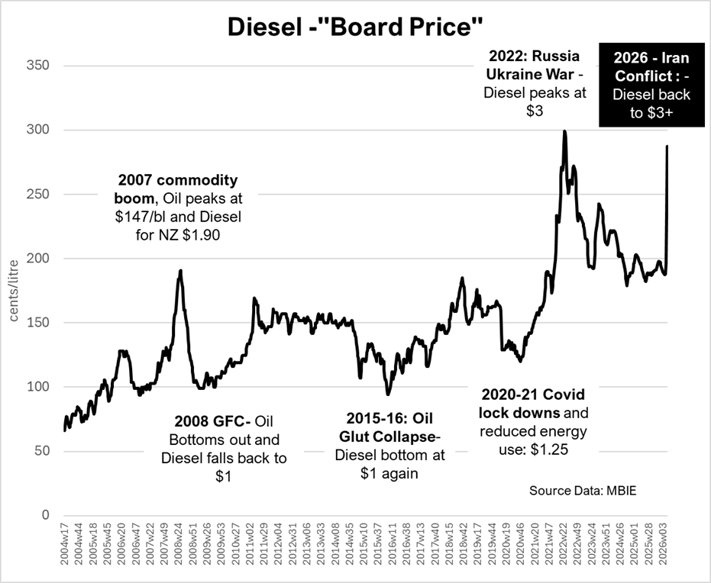
*In MBIE’s fuel data, “board price” is simply the headline pump price you see advertised at the station, before discounts – i.e. national average advertised retail price.
Just to be clear, the jump in diesel price we’re experiencing right now is significant- there has been a 70%+ increase since the conflict in Iran started. But at the same time, we saw a much larger spike in 2022 with the Russia/Ukraine conflict started (up over 100%). It’s also important to note that whilst diesel peaked at $3/L back then, the average 12 month price (6 months before to 6 months after) was actually $2.40.
Diesel remains one of the most exposed inputs from this conflict. On many New Zealand farms it represents a varying degree of total operating costs, particularly in arable and intensive systems plus in our contracting and transport community. In arable farming, this can make up 5-10% of operating costs (when at average diesel rates) and in contracting 12-20%.
However, farmers also face fuel cost increases indirectly via freight costs, R&M and imported goods.
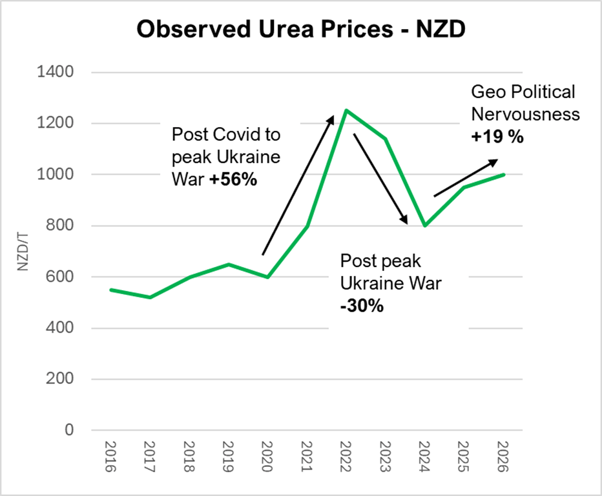
Fertiliser, particularly nitrogen-based products such as urea, is closely linked to global energy markets due to its reliance on natural gas. Price movements of 10% to 30% are realistic in a disrupted environment, with historical precedent for much larger spikes when supply chains tighten. We should not forget where we got to back to 2022 as per the graph below.
Chemicals, crop protection products, and general farm inputs are less volatile but still exposed through manufacturing and shipping costs, so have likely upward pressure. We have seen some one off large price increases for certain products in this category as well.
The key observation is that cost pressure is uneven. Some categories will move sharply, others gradually, and the timing will differ across the season.
The Real Issue Is Timing & Proactivity, Not Just Magnitude
The primary risk is not simply that costs increase, but that they increase at unpredictable points in the season. A known 20% increase can be planned for and absorbed into decisions. A late-season increase of 10%, after key inputs have been committed, often has a more damaging effect because there is lesser ability to respond.
This shifts the objective of budgeting away from prediction and toward adaptability. A strong budget allows for adjustment as conditions change rather than locking the business into a single set of assumptions.
A Cleaner Budget Structure: Separate the Base from the Volatility
A typical response to uncertainty is to apply a blanket uplift across all cost categories. While simple, this approach reduces clarity and can distort decision-making.
A more effective structure separates the budget into two components.
The first is a base budget, which reflects the farm operating under current known prices and conditions. This should be built using actual supplier quotes, contracted pricing, and realistic operating assumptions. It represents how the business would perform if conditions remained stable (and/or where prices can be fixed by forward ordering).
The second is a volatility layer, which captures potential movement in key cost categories. Rather than embedding this into every line item, it is treated as a separate, explicit set of contingencies. Diesel, fertiliser, freight, and feed are each assigned their own contingency allowance based on realistic exposure.
Replace Assumptions with Market Signals
Where possible, budgeting should be anchored in observable market signals rather than arbitrary percentage increases.
Forward pricing and supplier quotes provide the most reliable reference points. If fertiliser can be secured at a known price, that should form the base assumption. If diesel contracts are available, they should be considered not just for cost certainty but for supply security.
Breaking each cost into quantity and price components provides additional clarity. Understanding how many tonnes of fertiliser or litres of diesel are required allows the impact of price changes to be isolated and quantified. This approach avoids broad assumptions and replaces them with specific, measurable exposures.
Scenario Budgeting: Understanding the Range of Outcomes.
Given the uncertainty, a single budget may be insufficient. Running multiple scenarios provides a clearer view of potential outcomes.
A base case reflects current pricing and stable conditions. An expected case incorporates moderate increases across key inputs, such as diesel by, say, 50%* on last year and fertiliser by 25%*. A stress case models more severe disruption, with diesel increasing by a larger percentage (100%*) and fertiliser 40%*, alongside associated increases in feed and freight.
The purpose is not to predict which scenario will occur, but to understand how each would affect cashflow, working capital requirements, and operating margins.
(*these percentage increases are examples only and will be different for each farmer taking into account forward contracts, timing, existing supplies and economic viewpoint. Each farmer should consider their own situation independently)
Bank Engagement, Working Capital, and Funding Limits
Periods of volatility place increased importance on funding structure and proactive bank engagement. Cost increases do not occur evenly, and the resulting pressure is nearly always felt first in working capital rather than long-term profitability.
Farm businesses should ensure that working capital facilities are sized not just for the base budget, but for a stressed cost environment. Those higher cost scenarios should be run to work out the headroom that may be required above the base requirement to absorb input cost volatility without forcing reactive decisions. Make no mistake, funding availability directly impacts on a farmers’ confidence to carry out the operating strategy.
Engagement with banks should occur early, before pressure emerges. Providing lenders with scenario-based budgets demonstrates control and allows funding limits to be adjusted in a considered manner. This is materially different from seeking increases under time pressure, where options are more limited.
It is also important to understand the structure of existing facilities, including seasonal peaks, covenant requirements, and review periods.
Where appropriate, alternative funding sources can be considered to diversify working capital liquidity risk, particularly where traditional bank limits may be constrained. The objective is not to maximise debt, but to ensure sufficient access to capital to maintain operational stability.
A Note on What This Article Does Not Cover
This analysis is intentionally limited to the cost side of the farming business. Product pricing, including milk, meat, and crop returns, is subject to its own set of global drivers and can move independently of input costs. This is an extremely important point and one to keep in mind when fixing or agreeing to product prices. Similarly, interest rates and financing costs are influenced by monetary policy and broader economic conditions.
Both areas are critical and will require ongoing attention, but combining them into a single budgeting framework can sometimes reduce clarity. Separating cost management from revenue and financing decisions allows each to be addressed with greater precision.
Final Observation
Global volatility is not an isolated event; it is becoming a recurring feature of the operating environment. Understanding this and building adaptability and forward planning your business is not necessarily about accurately forecasting each movement, but from building systems that can absorb them.
Farm businesses that understand their cost structure at a detailed level, separate known costs from uncertain ones, and maintain sufficient liquidity will retain control over decision-making. Budgeting, in this context, becomes less about predicting outcomes and more about ensuring resilience under a range of conditions.
How NZAB Can Help
This type of environment is where structured financial thinking materially improves outcomes.
NZAB works alongside farmers to build clear, decision-ready budgets. This includes separating base costs from volatility, quantifying exposure across key inputs, and running scenario analysis to understand how changes flow through cashflow and profitability.
NZAB also supports each farmers bank engagement and funding strategy, ensuring working capital facilities are appropriately sized, structured, and aligned to the realities of the farming cycle. Where required, this extends to accessing alternative sources of capital to provide additional flexibility.
If you would like to sense-check your current budget, pressure test your cost assumptions, review your strategy or review your funding position ahead of the next season, NZAB can work through this with you in a structured and practical way.
Please click here to connect with our team, or here to send us a message via our website..png?width=940&height=348&name=Backing%20New%20Zealand%20Farmers%20with%20Capital%20That%20Fits%20(3).png)
Please feel free to share this newsletter with anyone you think may benefit from the content. You are also able to connect with us using the social media platforms below.
|
|
|


NZAB, 335 Lincoln Road, Addington, Christchurch, New Zealand 8024, 0800 NZAB 12
Unsubscribe Manage preferences