
Information only disclaimer. The information and commentary in this email are provided for general information purposes only. We recommend the recipients seek financial advice about their circumstances from their adviser before making any financial or investment decision or taking any action.
There has been no shortage of noise in agriculture over the last few years- interest rates, regulation, climate, politics and whipsawing commodity prices. But when you strip that away and look at the fundamentals, 2026 is shaping up as the start of one of the most interesting periods for farming businesses in more than a decade.
Balance sheets are stronger than most realise. The cost of capital has materially reset. Bank appetite is back. Non-bank capital is finally paying attention. And succession, long considered one of the most challenging issues in farming, is starting to be solved with better tools and innovative thinking.
Here are some of our key reasons for optimism:
1. Balance sheets are getting seriously strong.
From a dairy perspective, the last 3–5 years have generated substantial cash across most systems. Dairy debt has fallen to around $18.50/kgMS, down from a peak of approximately $22/kgMS. Adjusted for inflation, the reduction in real leverage is even more pronounced.
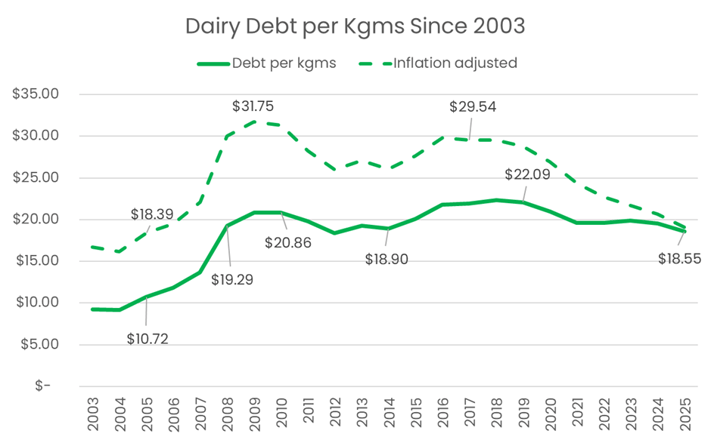
Layered on top of this, we’ve seen increases in land values, Fonterra share values, and livestock prices. Even after sensitising back from recent peaks, many balance sheets have experienced $6–$10/kgMS of asset value uplift.
Combine asset appreciation with debt reduction and the shift is material. A farm that may have been geared at 60% LVR prior to these changes, assuming no major structural changes, could now be sitting closer to 40–45% LVR. Businesses with average or below-average debt are even better positioned. Balance sheets are even stronger than the prevailing mood suggests.
It’s not universal. Sheep and beef has recovered sharply (see point 3), but low transaction volumes mean asset values are still finding their level. Some horticulture sectors - wine and certain apple varieties in particular - are currently at cyclical lows with real impacts on equity.
Ironically, horticulture has also been the sector most heavily supported by new bank debt over the past five years (around +10% p.a. debt growth since 2016, versus -1% p.a. in dairy and +2% p.a. in sheep and beef).
2. Interest rates have reduced significantly.
The impact of lower interest rates is two-fold.
The first is obvious: cashflow. At the peak, many farmers were paying 7–10% to their main bank just 18 months ago. Today, that’s typically 4–6%, with some cases starting with a “3”.
Using mid-points, that’s a move from 8.5% to 5%. For a dairy farm with above-average debt, that can equate to roughly 80 cents per kgMS improvement in cashflow. Similar relief applies across sheep and beef and cropping systems.
The second impact is more subtle but arguably more important: capital allocation.
When interest rates are high, investors can achieve attractive returns in deposits or bonds with minimal risk. As rates fall, capital is diverted back into productive investment - operating businesses, land, and growth opportunities.
This shift is already underway. Importantly, it’s not just underlying reference rates falling. Margins for farming have also improved, albeit unevenly, reinforcing the directional change.
3. The sheep and beef sector has roared back to life.
What felt like a crisis two years ago now looks more like a sharp cyclical correction.
Global supply and demand has rebalanced decisively in favour of New Zealand producers, with prices at or near record nominal levels. Its worth noting though, that when we adjust for inflation, returns are broadly the same as 2019–2022 levels, but that doesn’t diminish the turnaround.
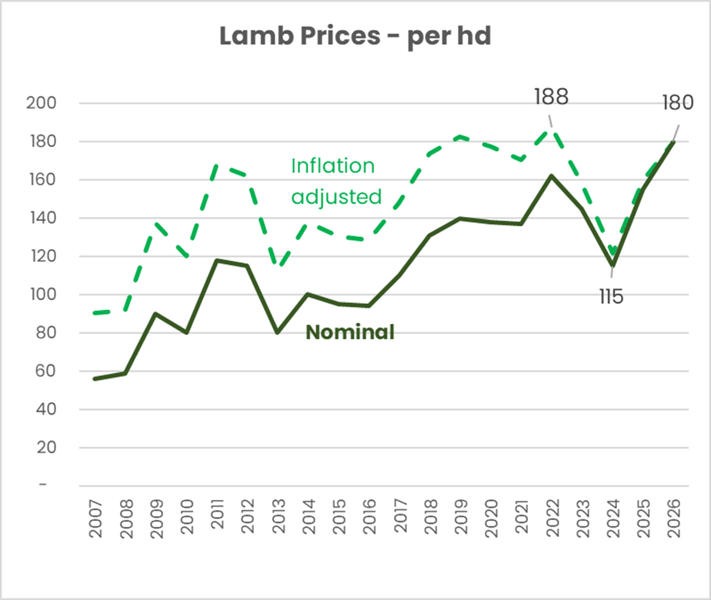
The recovery is real, margins have stabilised, and confidence is returning. That matters - not just for cashflow, but for reinvestment, succession, and long-term planning.
4. Bank appetite is stronger, with caveats.
This is one of the better periods of bank credit appetite we’ve seen since 2013–14, before the short (but sharp) dairy downturn and the subsequent tightening of regulatory and internal bank settings.
That said, appetite is highly variable. Outcomes depend heavily on how a credit is presented and whether farmers actively create competition. We still see interest rate spreads of up to 4% between best-in-market outcomes and very poor ones for similar risk profiles. Given lowering head count and the relative complexity of assessing agri credit, banks naturally remain selective about where they place their greatest focus so the need for a farmer (and their advisory team) to "own" the credit process is greater then ever.
In general, banks are engaging more constructively with farming businesses, particularly where governance, structure, and strategy are clear.
One caution: housing remains the banks’ traditional growth engine, and current housing credit growth is anaemic, not because banks don’t want it, but because confidence is subdued. When housing recovers, strategic focus and capital allocation will shift again. That will have flow-on effects for agri and business lending.
The recent banking inquiry didn’t result in substantive regulatory changes, but it did highlight a core issue: New Zealand’s capital system remains overly concentrated in housing. There is now a stronger political and institutional narrative around redirecting capital into productive sectors, including agriculture.
5. Other forms of capital are finally catching up with farming’s solid returns and lower risk profile.
For the first time in a while, there is genuine appetite to invest in farming businesses again.
The drivers are clear (albeit they haven’t changed!):
- Food security is back on the global agenda
- Productive land is scarce
- Well-run agri businesses generate real, durable cash yields
- Loss rates in agricultural lending remain low
Both onshore and offshore capital is better educated than it was even five years ago, with NZAB actively bringing new forms of capital to market, across both debt and equity, institutional and private.
We’re seeing new lending players, direct investors, and hybrid structures entering the market. In some cases, pricing is competitive with or cheaper than traditional banks, particularly where risk is well-structured.
Importantly, our farmers now have access to a much broader spectrum of capital. This allows funding structures to be tailored properly, rather than trying to maximise bank debt to get ahead. With multiple sources of capital available, our farming clients can match the right type of capital to the right part of the business and grow in a more sustainable, resilient way.
This is not theoretical. Capital is already flowing.
6. Succession is being reinvigorated on multiple fronts.
Succession has long been farming’s hardest problem, not because families didn’t care, but because the traditional tools are blunt and often arrived too late.
There is progress. Major industry participants - banks, processors, advisers - are becoming more involved earlier in the conversation. That engagement matters. But involvement alone is not the solution. The real challenge is that the old succession structures still don’t work for modern balance sheets, capital intensity, or family expectations.
This is where innovation is required, not just better timing, but better capital design and better connection with capital that wants to participate in farming – even the existing farmer capital that might want to exit but still wants to stay involved to some degree.
At NZAB, we are actively supporting a growing number of new entrants into first-farm ownership using connected and structured capital, deliberately aligning investor (or exiting farmer) requirements with high-quality farming talent. In practice, this means we are already implementing structures such as:
- Separating land ownership from operating businesses
- Designing staged equity pathways rather than large one-off transfers, including the use of vendor arrangement and lease to buy arrangements.
- Introducing third-party capital to de-risk retiring generations.
- Creating income certainty for parents without forcing full exits
But the next wave of capital innovation in farming is even more exciting. We have significant investor demand for simpler forms of investment into farming that don’t want to participate in typical governance or management systems - so we’re using innovative hybrid capital structures to sit alongside these farmers and the bank to achieve their farm ownership, expansion or succession goals.
Capital is the enabler of succession. It's also readily available and the farm investment returns are there, but it only becomes truly “connected” when it is structured to reflect the risk, return, and time horizons of everyone involved.
7. Governance is becoming a competitive advantage - when tailored properly.
Governance used to be seen as a corporate concept. In some respects, the first wave of “governance” in farming post GFC went too formal. Those who are getting it right today are setting things up much more dynamically, tailored to the personalities of those involved. This makes it enjoyable for farmers and therefore makes it stick, rather than something that disappears when the payout goes back up.
We’re seeing:
- Semi-formal boards or advisory groups focused on the future, not just history or compliance.
- Clear separation of ownership, governance, and management – not to follow the textbook, but to free up families to actually do what they are best at or actually want to do in life.
- Better decision-making around capex, leverage, and succession
- Less reliance on bank appetite as the sole decision filter, resulting in less exposure to the damaging impacts of cyclical credit appetite.
Done properly, and tailored to the people involved, governance is enjoyable and it attracts cheaper capital, enables expansion, and helps retain and attract talent. Done poorly, it adds cost and frustration. The difference is intent and fit.
What this means for the year ahead.
The fundamentals of farming in New Zealand are improving faster and sentiment is moving with it.
Balance sheets are strong. Cashflow pressure has eased. Capital - both bank and non-bank - is more available and more creative. Succession is no longer a problem to endure, but something that can be designed.
The opportunity in 2026 is not only to enjoy the current cycle, but to continue to position businesses for the next decade - with the right structure, the right capital, and the right people around the table.
That is something worth getting excited about.
.png?width=840&height=308&name=NZAB%20FLYER%20(1).png)
Please feel free to share this newsletter with anyone you think may benefit from the content. You are also able to connect with us using the social media platforms below.
|
|
|


NZAB, 335 Lincoln Road, Addington, Christchurch, New Zealand 8024, 0800 NZAB 12
Unsubscribe Manage preferences